
If you’ve ever been a print journalist, written technical documentation in an IT department, or worked on set, or really any other type of creative who is getting paid by someone else to create, you know there’s no time for writer’s or any other kind of block.
You’ve got a deadline, and you’ve got to hit it. You’ve got to get it right. You’ve got to get it first.
Miss it for no good reason, and you’re out on your ass.
You don’t get to say, “Hey boss, yeah, I know I’ve been covering this big breaking news story but uhhh, ya know, writer’s block kicked in, so I’m gonna take off a couple days and drink myself to oblivion. You’ll get your story when I sober up in a week.”
That’s not to say you don’t have to think about what you’re writing, or you won’t take long sips of coffee while you think of what to write next.
That’s not to say you won’t be stumped. That’s also not to say some days you may have nothing in the tank.
Being blocked is, ultimately, a choice. It is, as Steve Pressfield would say, Resistance.
I can hear the audible gasps… Pull out the fainting couches and smelling salts!
Here’s where I learned this …
I’m truly blessed to be from a family of journalists. My grandfather, P.J. (Pat) O’Brien, covered some of the biggest stories in the world in the 1920’s and 30’s before his life was tragically cut short in 1940 by kidney disease.
The biggest story he broke was that of the Hindenburg disaster.
He was a passenger on the October 9th, 1936 Hindenburg “Millionaire’s Flight.” This flight on Hindenburg was to show off the wonder of flying on a zeppelin. It was essentially a ten-and-a-half-hour-long fall foliage trip from Lakehurst, New Jersey, to New York City, up the Hudson River to Hartford, and finally Boston, then heading back.
Because of this, 209 days later, on May 6th, 1937, he again was at Lakehurst, this time covering the arrival of Hindenburg.
It was late. He was on a deadline and opened one of the only phone lines available to the Philadelphia Record City Desk to file his report while he waited.
At 7:25 PM, as Hindenburg erupted in flames. Into the blower, my grandfather yelled, “Stop the presses!” and began dictating his account off the top of his head to the stenographer.
Seventy minutes later, a special edition of the Philadelphia Record was on the streets of Center City and was the first account on the newswires around the globe. My grandfather’s photographer that day was Jack Snyder. His photo was actually the first photo of the explosion that the world saw.
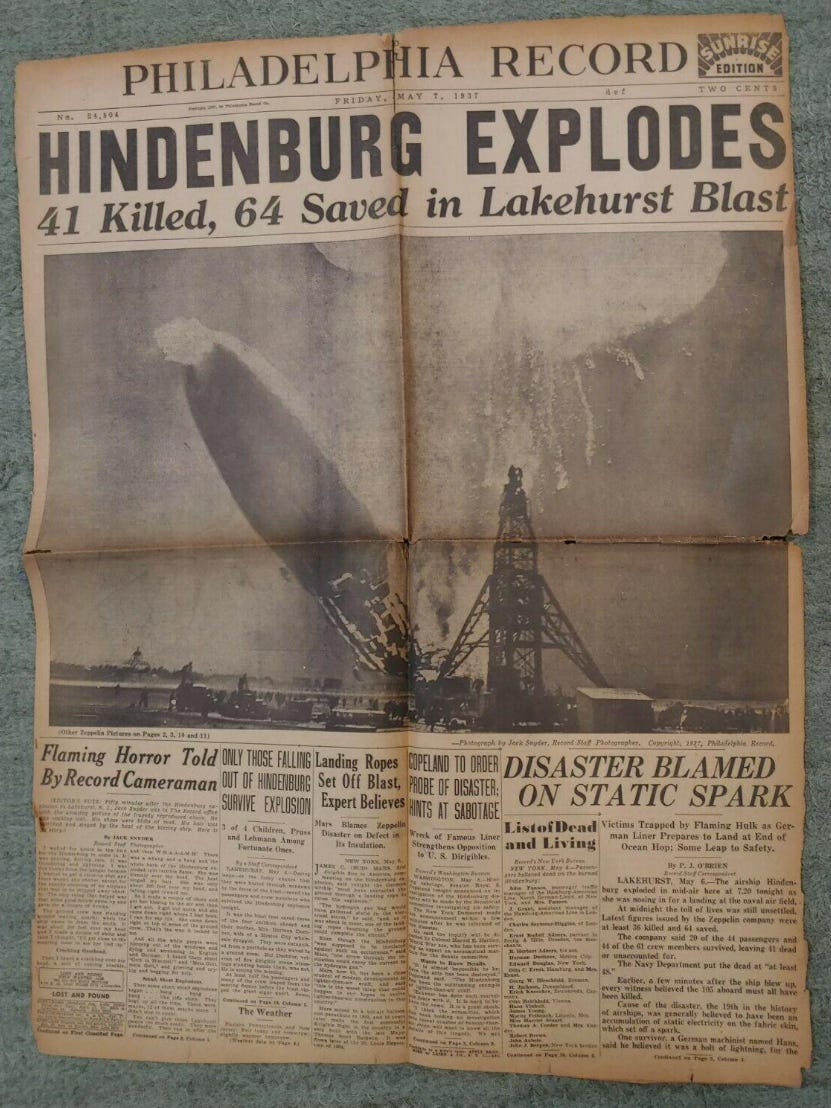
Contrary to popular belief, the photo taken by Sam Shere is often mistaken as the first, but it wasn’t. It became popular over the past fifty years because it was used on Zeppelin 1.
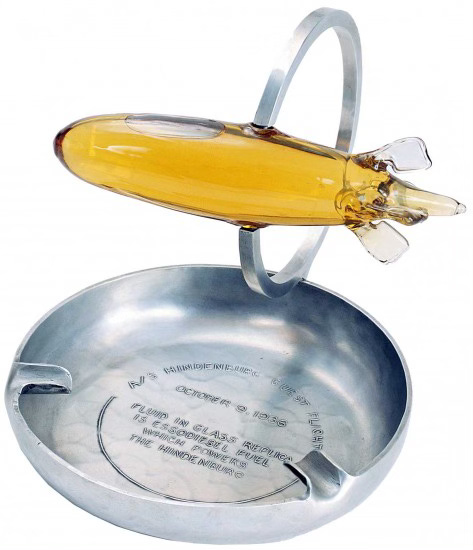
In any event, I heard the Hindenburg story from my mom and grandmom when I was growing up. My grandfather received an ashtray (similar to the one pictured above, though it now lacks the glass blimp) and an ice cream dish.
They are my talismans.
One of the nuggets from this story for me has always been that my grandfather just composed it off the top of his head, and they went to press with it.
It created in me the belief that acts of writing, and creative acts in general, are just something one does without much fanfare, not something to be labored over.
I’m not saying that one doesn’t have to think about what they’re working on. Good writing and creative endeavors demand a deep, thoughtful process.
I’d submit that if one lacks something in the process, they will inevitably say, “I’m blocked.”
Look at how many stories have been written about the romantic nature of being a blocked writer. That’s pretty, isn’t it? Makes you a real writer, somehow?
At this point, I find them lackluster and sordid.
The exception is the movie “Adaptation.” That’s OK, depending on which brother you identify with. Only one of them has what I consider the best response to The Notion of being blocked.
In “The War of Art” (page 64), Pressfield tells us of a quote by prolific playwright and novelist Somerset Maugham* who, when asked about writing on a schedule or when struck by inspiration, said, “I write only when inspiration strikes. Fortunately, it strikes me every morning at nine o’clock.”
The Notion leads some creatives down the path to inaction and not doing their work.
More often than not, there is not a trip to Tuscany involved, nor the aforementioned week-long bender, nor even a trip to the shore.
Strangely enough, The Notion is that it isn’t even a proper diagnosis of the issue!
The issue is, really, you’re missing something. Maybe you do need to inject some inspiration.
Watch a movie. Go to a museum. Read a book. Build a model railroad that you take pictures of on film, then self-develop the negatives at home using an AGO processor… Something out of your chair that’s not staring at the problem.
You need to take some time to figure out what’s missing, then get back to it immediately.
The story problem you have will still be there … Unless, of course, you quit. You can always do that, but the pain of not doing your work is worse than working your way through.
For me, I don’t worry about The Notion. After thirty years of writing, I can safely say I will never be blocked.
I will always properly identify what the hell it is and deal with that.
I invite you to do the same.
Are you confident that you are a writer, cinematographer, director, or other creative?
Do you believe in yourself as a writer?
If you’ve read this far, you should.
You will only solve your story problem by working through it, not by calling it something it is not or pretending otherwise.
Now, get off your ass and go be brilliant!
Next, 005: Flying from your fingers.
*= Happy belated birthday, Somerset. He would have been 152 on January 25th.